
Sulfur Cube Guide for BE: Every Type and Behavior Explained
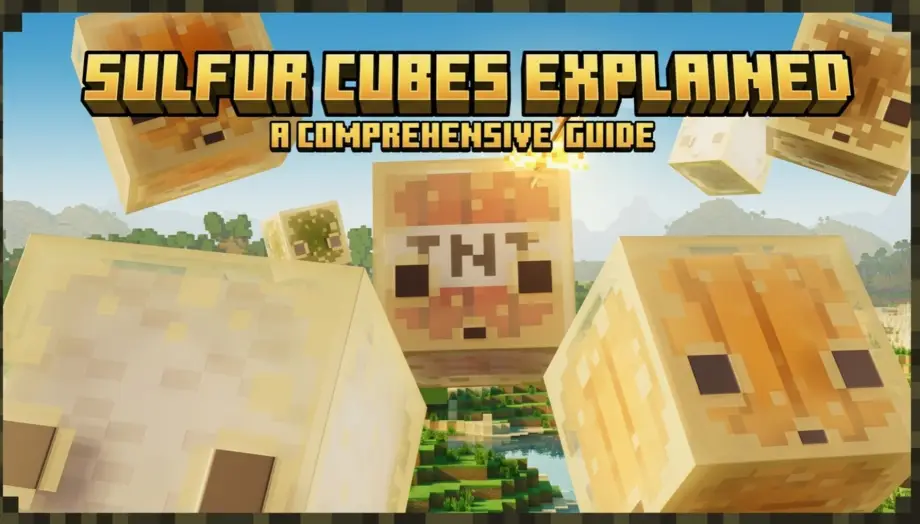
The sulfur cube is unlike anything Minecraft has had before. It's a passive mob that eats blocks and turns into a physics toy. Feed it wood and it bounces off walls like a rubber ball. Feed it ice and it slides across the floor like a hockey puck. Feed it TNT and it becomes a bomb you can punt across the room. Every block changes the cube's speed, bounciness, friction, and weight, creating 12 distinct archetypes that open up minigames, traps, redstone contraptions, and general chaos.
This guide covers every archetype, which blocks trigger each one, and what you can actually do with them.
The Basics: How Sulfur Cubes Work
Before we get into archetypes, here's how the mob itself works:
- Sulfur cubes spawn exclusively in sulfur caves, a new underground biome added in the Chaos Cubed update (Bedrock 26.30).
- Only large sulfur cubes can absorb blocks. Small ones can't.
- Feed a block to a large cube by holding the block and interacting with it, or by dropping the block near it.
- Once a cube absorbs a block, it stops moving, becomes immune to most damage, and turns into a ball you can hit around.
- The direction and distance it flies depends on where you hit it and how hard (stronger weapons = more force, Knockback enchantment adds power).
- Use shears on a cube to remove the absorbed block and reset it.
- Feed a cube a different block to swap archetypes instantly (the old block pops out).
- Pick up a cube with an empty bucket to transport it. The bucket keeps the absorbed block inside.
- When killed, large cubes split into 2 small cubes. Feed small cubes slimeballs to grow them back into large ones.
The cube rejects slabs, stairs, walls, fences, glass, and functional blocks (crafting tables, furnaces, chests, pistons, etc.). Only full-sized solid blocks are accepted.
All 12 Archetypes
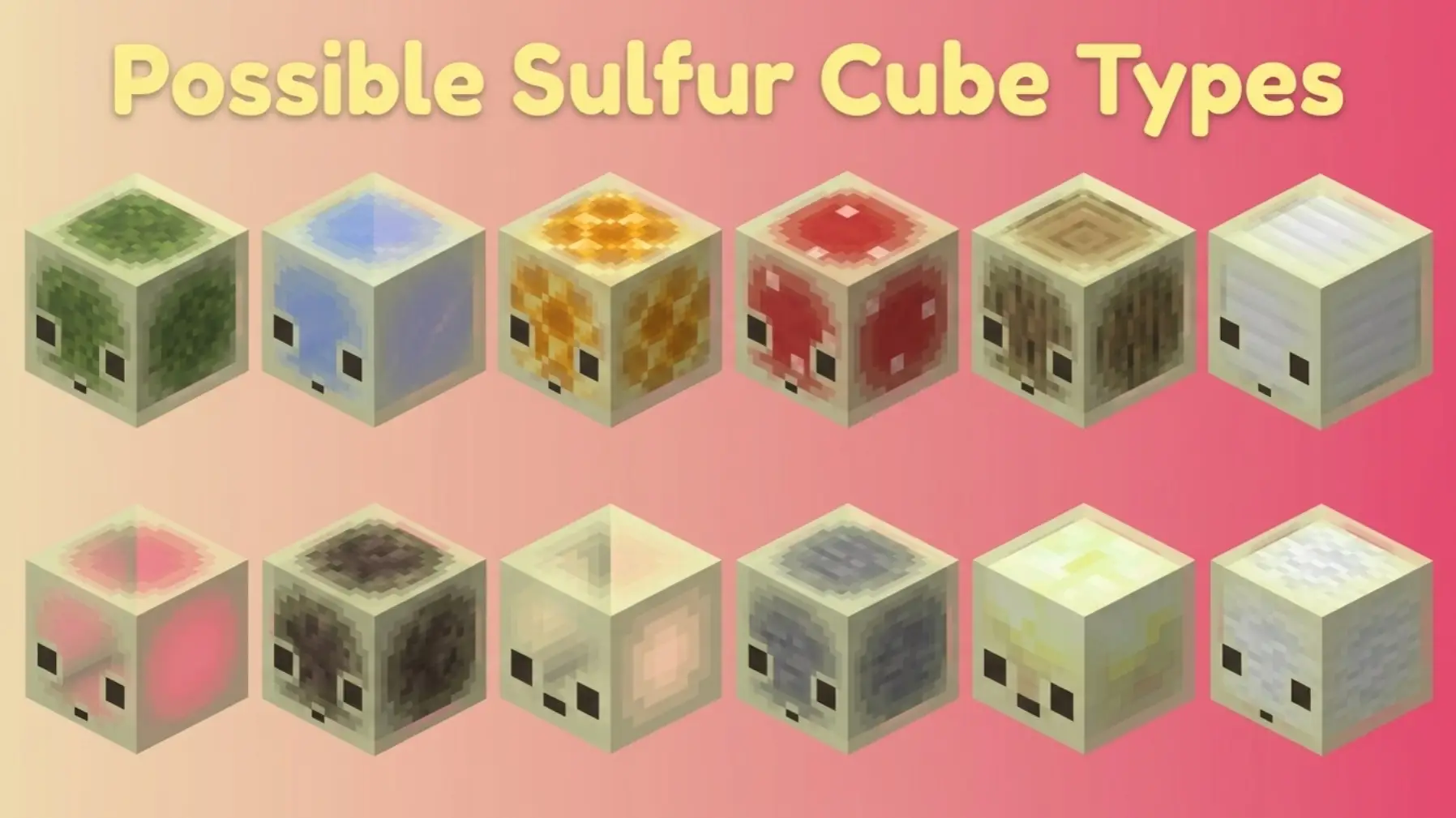
🟫 Bouncy (Rubber Ball)
Blocks: any wood planks, logs, stripped logs, wood, stripped wood, bamboo blocks, resin blocks
High bounce, low friction, flies far when hit. This is the classic rubber ball and the most popular archetype for minigames. The cube ricochets off walls and floors with satisfying energy and floats in water. If you're building a pinball machine, this is what you want.
🟩 Fast Flat (Golf Ball)
Blocks: moss blocks, coral blocks, sponge, dried kelp blocks, pumpkins, melons, hay bales, froglights
Fast lateral speed, moderate bounce, significant slide distance. Travels long and low like a golf ball on a fairway. Works great for long-distance target games. Pair with soul sand "putting greens" at the end for precision stopping.
🧊 Fast Sliding (Hockey Puck)
Blocks: blue ice, packed ice, snow blocks
Near-zero friction, zero bounce. The cube glides across flat surfaces in a straight line with almost no resistance. The fastest horizontal archetype in the game. Sinks in water. Build an ice rink and use this for curling or hockey minigames.
🍄 Slow Sliding (Curling Stone)
Blocks: brown mushroom block, red mushroom block, mushroom stem, mycelium, nether wart block, warped wart block, shroomlight
Gradual, deliberate sliding movement with no bounce. Slower than fast sliding but more predictable. Sinks in water. Ideal for precision-based games and redstone setups where you need controlled, repeatable motion.
🪨 Slow Bouncy (Bowling Ball)
Blocks: stone, cobblestone, deepslate, concrete, bricks, ore blocks, and most stone-type blocks
Slow speed with a heavy, controlled bounce. Medium friction. Moves like a medicine ball that still has some life in it. Good for bowling-style games: line up High Resistance cubes as pins and roll a Slow Bouncy cube at them.
⚽ Regular (Football)
Blocks: grass blocks, dirt, sand, gravel, terracotta, glazed terracotta, and any block that doesn't match another archetype
Balanced across the board: medium speed, medium bounce, medium friction. This is the default fallback for blocks that don't fit a specific category. Fun fact: white glazed terracotta makes the cube look like a football (soccer ball).
🪶 Light (Balloon)
Blocks: any wool block (all 16 colors)
Reduced gravity, high air drag. The cube doesn't just bounce, it floats and lingers in the air. Moves slowly but stays airborne much longer than any other archetype. Floats in water. Great for parkour, floating platforms, or anything where you want slow vertical movement.
⚓ High Resistance (Anchor)
Blocks: iron blocks, gold blocks, copper blocks, and other metal blocks. Also soul sand and soul soil.
Maximum knockback resistance. The cube barely moves when hit, even with a Knockback II netherite sword. It just sits there like an anchor. Sinks in water fast. Use these as immovable obstacles, bowling pins, or barriers in minigame courses.
🍯 Sticky (Beanbag)
Blocks: honeycomb block
Highest friction in the game (2.0). Zero bounce. The cube launches upward when hit but stops dead the instant it lands. It clings to surfaces and refuses to slide. Sinks in water. Players have used this to build working monorail-style transport systems.
🔥 Hot (Damage Ball) — SPECIAL
Blocks: magma block
Regular ball physics, but the cube damages any entity that touches it, exactly like standing on a magma block. Floats in water. Use it to build passive mob traps, damage corridors, or defensive perimeters. Handle with care near other players and your pets.
💥 Explosive (Mobile TNT) — SPECIAL
Blocks: TNT
The cube visibly holds TNT inside its body. Ignite it with flint and steel, a Fire Aspect weapon, or a redstone signal, and it starts a 6-second fuse. Then it explodes, killing the cube and everything nearby. No small cubes survive. Shears cannot defuse an ignited cube. There is no undo.
The tactical use: hit the cube to launch it toward a target, then ignite it mid-flight with a flame arrow. Mobile TNT delivery system. Test in Creative first.
If another explosion triggers it, the fuse is random (0.75 to 3 seconds) instead of the standard 6. Respects the "TNT Explodes" and "Mob Griefing" game rules.
What Sulfur Cubes Can't Absorb
The cube is picky. It only accepts full-sized solid blocks. Here's what gets rejected:
- Slabs, stairs, walls, fences, fence gates
- Glass and glass panes
- Functional blocks: crafting tables, furnaces, enchanting tables, anvils, pistons, observers, chests, barrels, hoppers
- Doors, trapdoors, buttons, levers, pressure plates
- Torches, lanterns, candles
- Beds, banners, signs
- Any non-full-block shape
If the cube ignores the block you're holding, it's because the block doesn't qualify. Switch to a full-sized block and try again.
Water Behavior
Not all archetypes behave the same in water:
Floats: Bouncy, Regular, Hot, Light
Sinks: Fast Flat, Fast Sliding, Slow Sliding, Slow Bouncy, High Resistance, Sticky
This matters for water-based minigames and transport. If you're building a water channel delivery system, use floating archetypes. If you need the cube to drop through water, use a sinking one.
Practical Uses and Minigame Ideas
Pinball machine. Bouncy (wood) cubes in a walled course. Hit them with a sword to launch. Add redstone scoring mechanisms with pressure plates or tripwires.
Bowling alley. Slow Bouncy (stone) cube as the ball. High Resistance (iron) cubes as pins. Set up a lane and aim for strikes.
Curling arena. Fast Sliding (ice) cubes on a polished surface. Closest to the target wins. Works surprisingly well in multiplayer.
Mob trap. Hot (magma) cubes in a narrow corridor. Mobs take contact damage as the cube bounces around. Low-cost, no redstone needed.
TNT cannon. Explosive cubes launched with a Knockback II sword toward a target. Ignite with a flame arrow mid-flight. Extremely fun, extremely dangerous.
Floating parkour. Light (wool) cubes as platforms that slowly drift upward. Players jump between them. Timer-based: if you're too slow, the platform floats away.
Transport system. Sticky (honeycomb) cubes on a rail of blocks, pushed by pistons. They stop exactly where they land, making them predictable for station-based transport.
Bedrock-Specific Notes
A few things that work differently on Bedrock compared to Java:
Airborne knockback is stronger. On Bedrock, sulfur cubes in the air get knocked even further when hit again. On Java, airborne hits don't add extra distance. This makes Bedrock better for chain-hit minigames where you keep the cube airborne.
Some block assignments may differ. Resin blocks and a few organic blocks are categorized slightly differently between editions. If a block doesn't trigger the archetype you expected, check the wiki for Bedrock-specific tags.
Sulfur cubes spawn in normal and peaceful mode. On Bedrock 26.30, sulfur cubes spawn during regular gameplay including Peaceful difficulty. You don't need an experimental toggle anymore.
How to Get Sulfur Cubes Home
Sulfur caves can be deep underground and far from your base. Here's how to transport them:
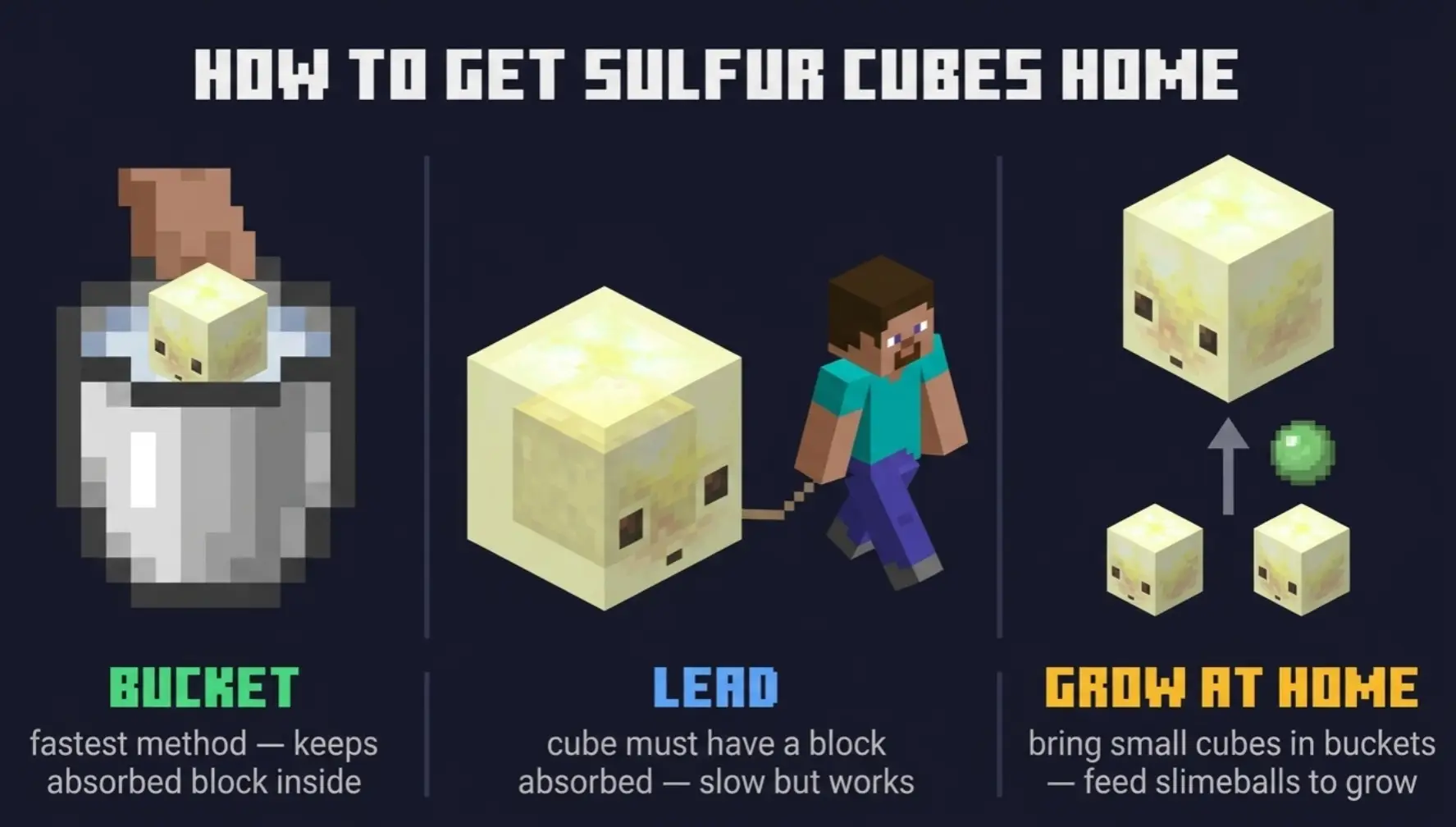
Bucket. Use an empty bucket on a sulfur cube to scoop it up. The bucket stores the cube including whatever block it has absorbed. Place it wherever you want later. This is by far the easiest method.
Leads. Sulfur cubes with an absorbed block can be leashed. Attach a lead and walk them home. Slow but doesn't cost a bucket.
Slimeball breeding. If you only find small cubes, bring them home in buckets and feed them slimeballs to grow them into large cubes on-site. Cheaper than transporting large ones through cave systems.
The sulfur cube is Minecraft's first true physics mob. Twelve archetypes, each with distinct behavior, all controlled by which block you feed it. The basics are simple: wood = bouncy, ice = sliding, wool = floaty, TNT = explosive. But the depth comes from combining archetypes with builds, redstone, and multiplayer creativity. Bookmark this page, experiment in Creative, and when you find a combination that works, bring it to survival.