
How to Breed Villagers in Minecraft Bedrock
Villagers are arguably the most useful mob in Minecraft. They sell enchanted books, diamond gear, food, and just about everything you need for endgame. But villages only spawn with a handful of them, and losing one to a zombie raid can set you back hours. The solution? Breed your own.
Breeding villagers isn't as simple as feeding two animals and waiting for a baby. It involves beds, food points, population checks, and a few Bedrock-specific quirks that make things work a bit differently from Java. This guide covers exactly how it works, what you need, and what to do when they refuse to cooperate.
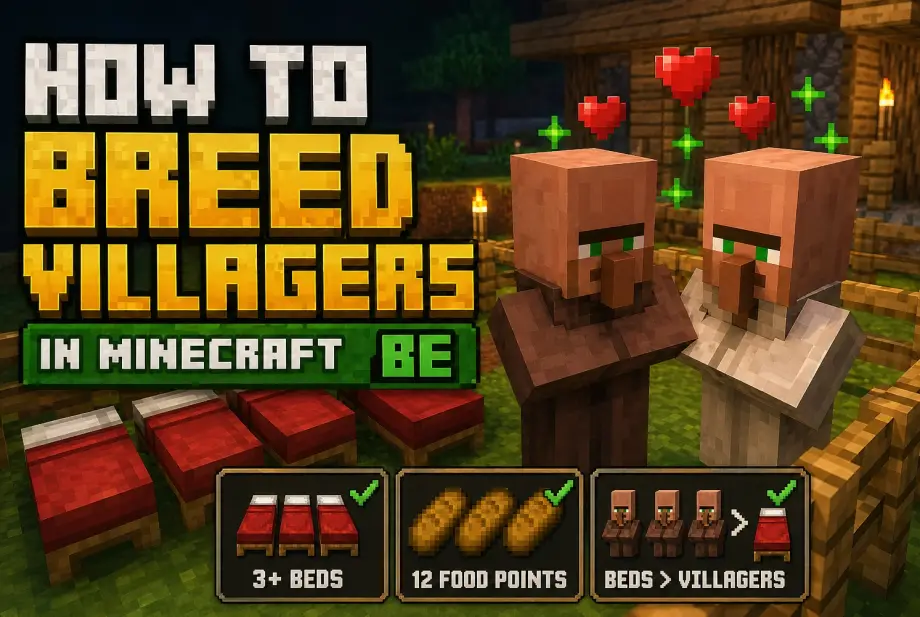
The Three Things Villagers Need to Breed
Every villager breeding attempt comes down to three requirements. Miss any one of them and nothing happens. No error message, no feedback, just two villagers staring blankly at each other.
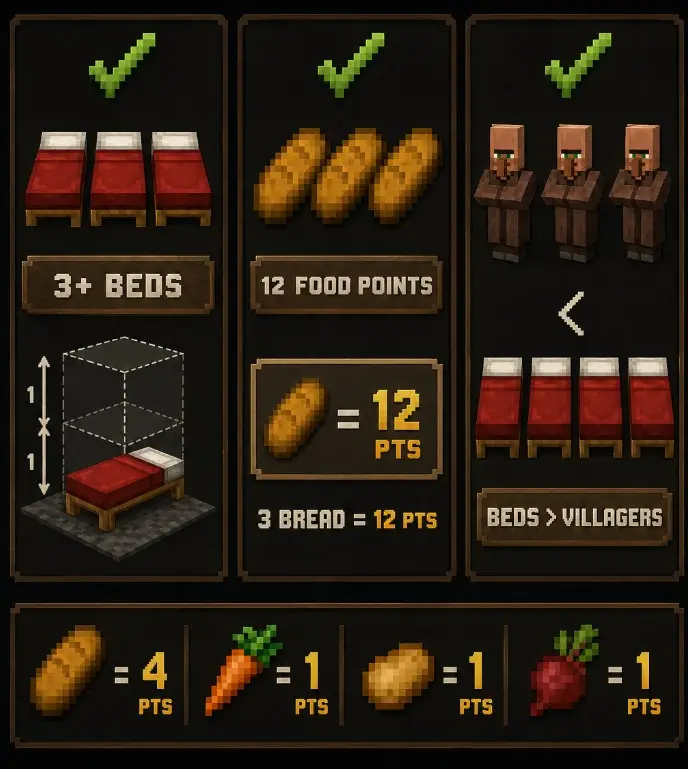
1. At least three beds. One for each parent and one for the baby. Every bed must have at least two full blocks of open space above it. This is crucial. If you put a slab or a stair block above a bed, villagers don't count it as valid. Each bed must also be unclaimed, meaning no other villager has already linked to it.
2. Enough food. Each villager needs 12 food points in their inventory to become willing to breed. You feed them by throwing food items on the ground near them. They'll walk over and pick it up. The food point values are:
- Bread — 4 points (so 3 bread = 12 points, the most efficient option)
- Carrots — 1 point each (need 12)
- Potatoes — 1 point each (need 12)
- Beetroots — 1 point each (need 12)
Bread is the easiest choice. Three loaves per villager and they're good to go. You can mix and match food types as long as the total reaches 12 points.
3. Population must be below the bed count. Villagers on Bedrock periodically take a census of the village population. If the number of villagers is equal to or greater than the number of beds, breeding stops. You always need more beds than villagers for breeding to continue.
Step-by-Step: How to Breed Villagers
Step 1: Get Two Villagers Into an Enclosed Space
You need at least two adult villagers. If you're near a village, you can use them directly. If you need to move them, your options are:
- Boats — push a villager into a boat, get in, and drive. Works on land too, just slower.
- Minecarts — place a rail and push a minecart into the villager. Most reliable for long distances.
- Just build around them — if the villagers are already where you want them, sometimes it's easier to build the breeding room around them.
Put them in a room that's enclosed, well-lit (to prevent hostile mob spawns), and big enough for them to move around. Something like a 5×5 room with a 3-block-high ceiling works perfectly.
Step 2: Place the Beds
Place at least three beds inside the room. Make sure each bed has two full blocks of air above it. Not slabs, not stairs, not trapdoors. Full air blocks. Villagers treat slabs and similar blocks as full blocks for pathfinding, so they'll ignore beds with those above them.
On Bedrock, bed pathfinding is more forgiving than Java. The beds just need to be nearby and in the same general area. But they still need that headroom, so don't skip it.
Step 3: Feed Them
Throw food at the villagers. Literally. Hold the food and drop it near them (long press on mobile, Q on PC). They'll walk over, pick it up, and start accumulating food points.
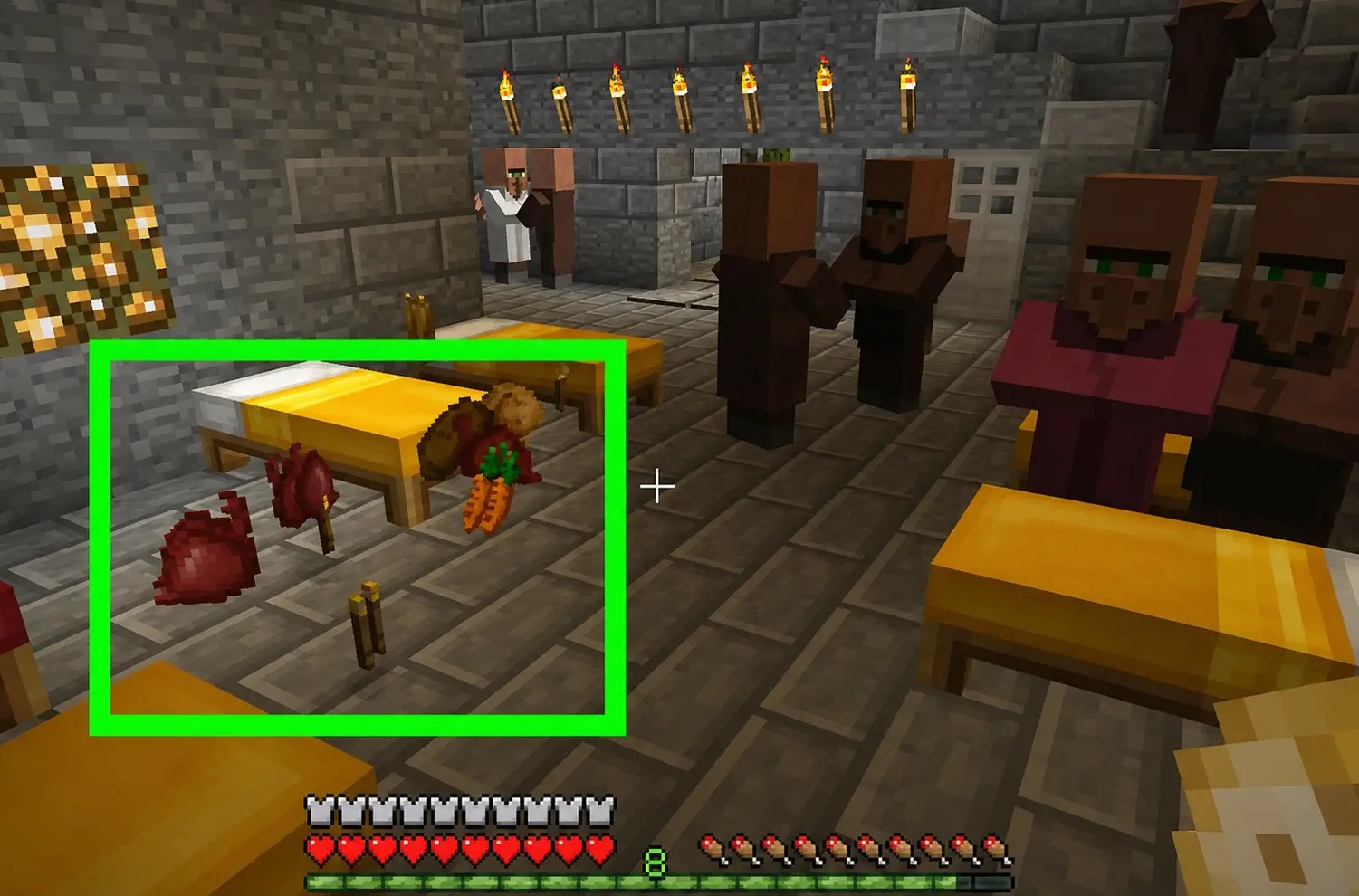
Give each villager at least 3 bread or 12 carrots/potatoes/beetroots. Once they have enough food, they become "willing" to breed. You'll know it's working when you see heart particles above their heads.
Step 4: Wait
If both villagers are willing and there's an available bed for the baby, they'll face each other, produce heart particles, and a baby villager will appear. The baby takes 20 minutes to grow into an adult.
Want more babies? Add more beds and more food. On Bedrock there's no breeding cooldown like Java has, so willing villagers will breed again immediately as long as beds and food are available.
The Food Point System Explained
This is the part that confuses people the most. Each villager needs a total of 12 food points to become willing. The points are consumed when breeding is attempted, whether it succeeds or not. So if a breeding attempt fails (no available bed, for example), the food is still used up and you'll need to feed them again.
Here's a quick reference for how much food to throw at each villager:
- 3 bread = done (3 × 4 = 12 points)
- 12 carrots = done
- 12 potatoes = done
- 12 beetroots = done
- 1 bread + 8 carrots = done (4 + 8 = 12 points)
Bread is easily the most practical because you need far fewer items. If you have a wheat farm, just craft bread and throw it at them.
Bedrock vs Java: What's Different
There are some meaningful differences that affect how you design your breeder.
No breeding cooldown on Bedrock. On Java, villagers wait 5 minutes between breeding attempts. On Bedrock, there's no cooldown. If they have food and beds are available, they'll breed again right away. This means Bedrock breeders can produce villagers much faster.
Population cap works differently. On Bedrock, all villagers within the horizontal boundary of the village count toward the population cap, not just the ones near the beds. If there are too many villagers in the area already, breeding stops even if you have plenty of beds in your breeder. The fix is to move baby villagers away from the breeding area quickly (more on that below).
Bed pathfinding is simpler on Bedrock. On Java, villagers must physically path-find to a bed for it to count. On Bedrock, beds just need to be nearby and within loaded terrain. This makes bed placement less finicky, but the two-block headroom rule still applies.
Villager appearance is biome-based. On Bedrock, the baby's appearance is determined by the biome where breeding occurs, not by the parents' biome type. Breed two tundra villagers in a desert, and the baby looks like a desert villager.
Building a Simple Breeder
You don't need a complex redstone contraption. Here's a basic design that works reliably on Bedrock:
- Build a 5×5 room with walls 3 blocks high
- Place 4 or more beds inside (more beds = more breeding capacity)
- Make sure each bed has 2 blocks of air above it
- Light up the room well (torches, lanterns, whatever) so no mobs spawn inside
- Get 2 villagers inside using boats or minecarts
- Throw 3 bread at each villager
- Wait for hearts to appear
To keep the breeder running continuously, you need to move baby villagers out of the room so they don't claim beds and block the next breeding cycle. A simple water channel that pushes babies to a separate holding area works well. Or you can just manually move them out with a boat once they spawn.
Automatic Breeder Using a Farmer Villager
If you want a breeder that runs without your input, add a farmer to the mix.
Farmer villagers (the ones with straw hats) automatically harvest crops and throw excess food to other villagers. If you give a farmer access to a small crop farm inside or next to the breeding area, they'll feed the breeders for you.
Here's the idea:
- Set up a small farm plot (even a 4×4 patch of farmland works)
- Plant carrots or potatoes (these work better than wheat for auto-feeding because farmers throw them directly, whereas wheat needs to be crafted into bread first)
- Assign one villager as a farmer by placing a composter nearby
- The farmer harvests, picks up extra crops, and throws food to the other villagers
- The other villagers eat the food, become willing, and breed whenever beds are available
One important note: the gamerule mobGriefing must be set to true (which is the default). If it's set to false, villagers can't pick up food items and the entire system breaks.
Why Your Villagers Aren't Breeding (Troubleshooting)
"I gave them food and beds but nothing happens." Check the ceiling height above the beds. Even one slab or stair block above a bed invalidates it. The beds need a full two blocks of open air space above them.
"Hearts appear but no baby shows up." The beds might be claimed by other villagers you can't see. On Bedrock, villagers can claim beds from surprisingly far away. Try breaking and replacing the beds, or add more beds than you think you need.
"They bred once and then stopped." The population has hit the bed limit. You either need more beds or you need to move existing villagers (including babies) away from the breeding area so they unclaim the beds.
"The farmer villager isn't throwing food." Make sure mobGriefing is set to true. Also, farmer villagers only throw food when they have more than they need. If the farm is too small or the farmer keeps eating the crops themselves, there won't be excess to share.
"Villagers keep panicking instead of breeding." There's a hostile mob nearby. Villagers won't breed if they're scared. Check for zombies, pillagers, or other threats in the area. Light everything up and make sure the room is fully enclosed.
"Baby villagers are disappearing." They're probably not disappearing. They're fast, tiny, and love to sprint around. They might be slipping through gaps you didn't notice. Make sure your enclosure has no 1-block-wide gaps, because babies can fit through them.
What to Do With Your New Villagers
Once you've got breeding working, the real fun starts.
Trading hall. Move each new villager to an individual cell with a workstation. Assign them professions by placing the right job block (lectern for librarian, smithing table for toolsmith, etc.). Reroll trades by breaking and replacing the workstation until you get what you want. Then trade with them once to lock in the profession.
Iron golem farm. Iron golems spawn naturally when enough villagers are present and scared. A dedicated iron farm uses a group of villagers, a zombie to scare them, and a kill chamber for the golems. It produces hundreds of iron ingots per hour, and all you need to fuel it is a steady supply of villagers.
Zombie villager curing. Breed villagers, let a zombie convert them on Hard difficulty (100% conversion rate), then cure them with a weakness potion and golden apple. The cured villager gives permanent trade discounts. This is how you get Mending books for 1 emerald.
Before you go
Breeding villagers on Bedrock comes down to three things: beds with headroom, 12 food points per villager, and a population that hasn't hit the cap. Get those right and the rest takes care of itself. Bedrock's lack of breeding cooldown makes the process faster than Java once you've got the setup working, and a farmer villager can automate the food distribution entirely.
Start with three beds, two villagers, and a handful of bread. Scale up from there. Before you know it you'll have more villagers than you know what to do with, which is exactly the kind of problem you want to have.