


Coelacanth Add-on
 Go to files
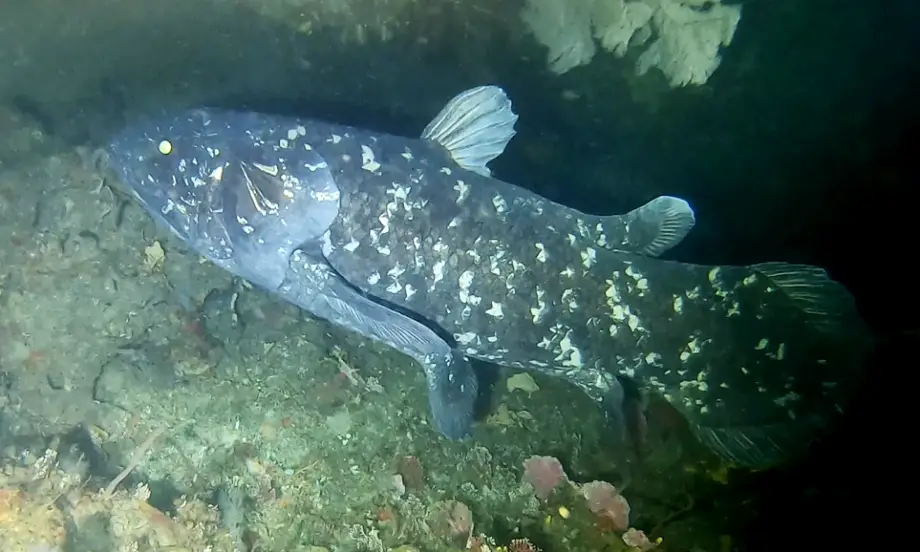
The coelacanth (SEE-luh-kanth) is a rare, ancient group of lobe-finned fish often called a "living fossil". Thought to have gone extinct alongside the dinosaurs 65 million years ago, a living specimen was shockingly discovered in 1938. They are famous for their limb-like fins and evolutionary link to land-dwelling vertebrates.

This is a coelacanth fish, a fish that is already familiar to us. This fish really avoids sunlight because this fish really loves its territory, Because if they swim too far they will return to their home. These fish are slow and have tough meat which many other fish don't want to eat.
What is Coelacanth?
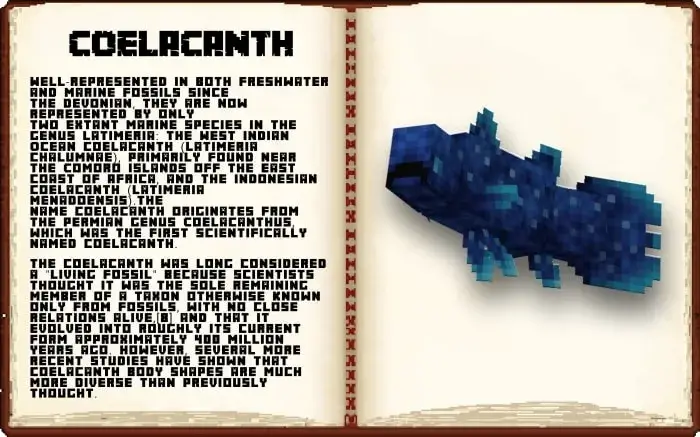
Coelacanths (/ˈsiːləkænθ/ ⓘ SEE-lə-kanth) are an ancient group of lobe-finned fish (Sarcopterygii) in the class Actinistia.[2][3] As sarcopterygians, they are more closely related to lungfish and tetrapods (the terrestrial vertebrates including living amphibians, reptiles, birds and mammals) than to ray-finned fish. There is only a single living genus, Latimeria, with two described species.
The name coelacanth originates from the Permian genus Coelacanthus, which was the first scientifically named genus of coelacanths (in 1839), becoming the type genus of Coelacanthiformes as other species were discovered and named.[4][5] Well-represented in freshwater and marine deposits from as early as the Devonian period (more than 410million years ago), they were thought to have become extinct in the Late Cretaceous, around 66million years ago.
The first living species, Latimeria chalumnae, the West Indian Ocean coelacanth, was described from specimens fished off the coast of South Africa from 1938 onward;[6][7] they are now also known to inhabit the seas around the Comoro Islands off the east coast of Africa. The second species, Latimeria menadoensis, the Indonesian coelacanth, was discovered in the late 1990s, which inhabits the seas of Eastern Indonesia, from Manado to Papua.[8]
Coelacanths (or more accurately, the extant genus Latimeria) is often considered an example of a "living fossil" in popular science because it was considered the sole remaining member of a taxon otherwise known only from fossils (a biological relict),[9][10]: 1 evolving a bodyplan similar to its current form approximately 400million years ago.[1] However, studies of fossil coelacanths have shown that coelacanth body shapes (and their niches) were much more diverse than what was previously thought, and often differed significantly from Latimeria.[11][12][13]
Credits
Yushige-sun for the coelacanth model





![Thumbnail: More Armor Weapons Tools and Swords Items Mod! – 𝗠𝗶𝗻𝗲𝗰𝗿𝗮𝗳𝘁 𝗙𝗼𝗿𝘁𝗶𝗳𝘆 𝗥𝗲𝘄𝗼𝗿𝗸𝗲𝗱 [v1.0.2] [New Mods New Addons Update!] [Compatible with any Addon!]](/uploads/posts/2025-02/b0534b5772_minecraft-fortify-cover.webp)