
Abandoned Camps in Minecraft: Everything You Need to Know
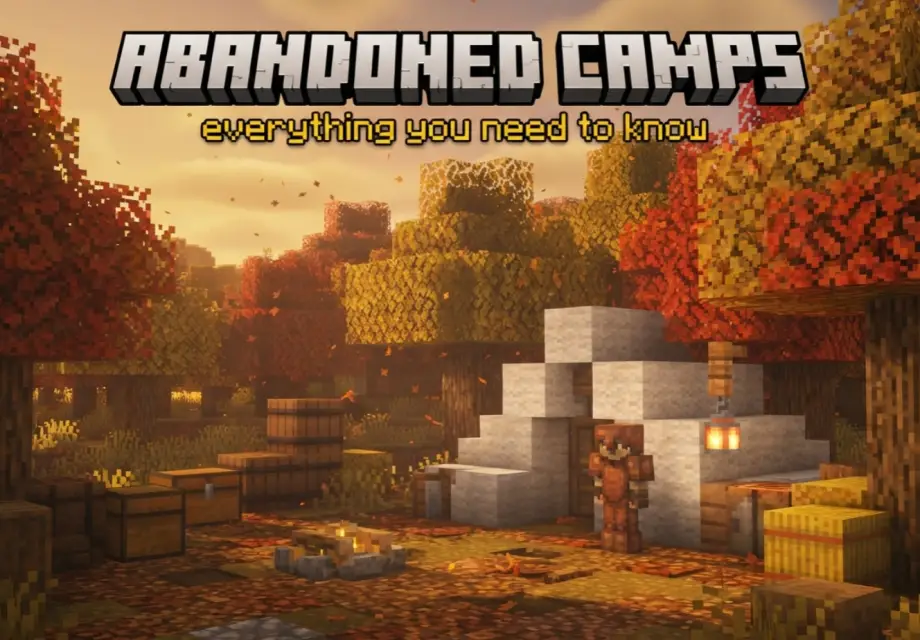
Minecraft is getting a new structure, and it might be the most useful early-game find since the village. Abandoned camps are small surface campsites scattered across the Overworld: a wool tent, a cold campfire, barrels of supplies, and if you look carefully, a hidden chest with genuinely good loot.
They're part of the Third Drop of 2026, the autumn-themed update built around the new dappled forest biome. Here's what we know so far, what's still changing, and how to make the most of them when they land.
Quick Answers
- What is it? A small surface structure: a tent made of wool stairs with chests, barrels, and camp furniture
- Where does it spawn? Overworld surface biomes, above ground only. No digging required.
- Is it rare? No. Unlike woodland mansions or ancient cities, camps are common enough to find during normal travel.
- What's the loot? Food, tools, copper gear, and rarely a hidden oxidized copper chest with much better rewards
- Can I get it now? Only in preview/experimental builds. Full release is scheduled for Q3 2026.
Release Status: Read This First
This is where a lot of the coverage online gets confusing, so let's be precise.
Abandoned camps were announced at Minecraft Live on May 30, 2026 as part of the Third Drop of 2026. Mojang's official Minecraft Preview 26.40.27 changelog (June 23, 2026) confirms that abandoned camps with chests and barrels are findable in that preview build, including a dappled forest variant.
That said, the feature is experimental and pre-release. On Bedrock, the camp structure files sit inside an experimental behavior pack, meaning you need experiments enabled in a Preview build to see them. The full drop is targeted for Q3 2026.
What an Abandoned Camp Looks Like
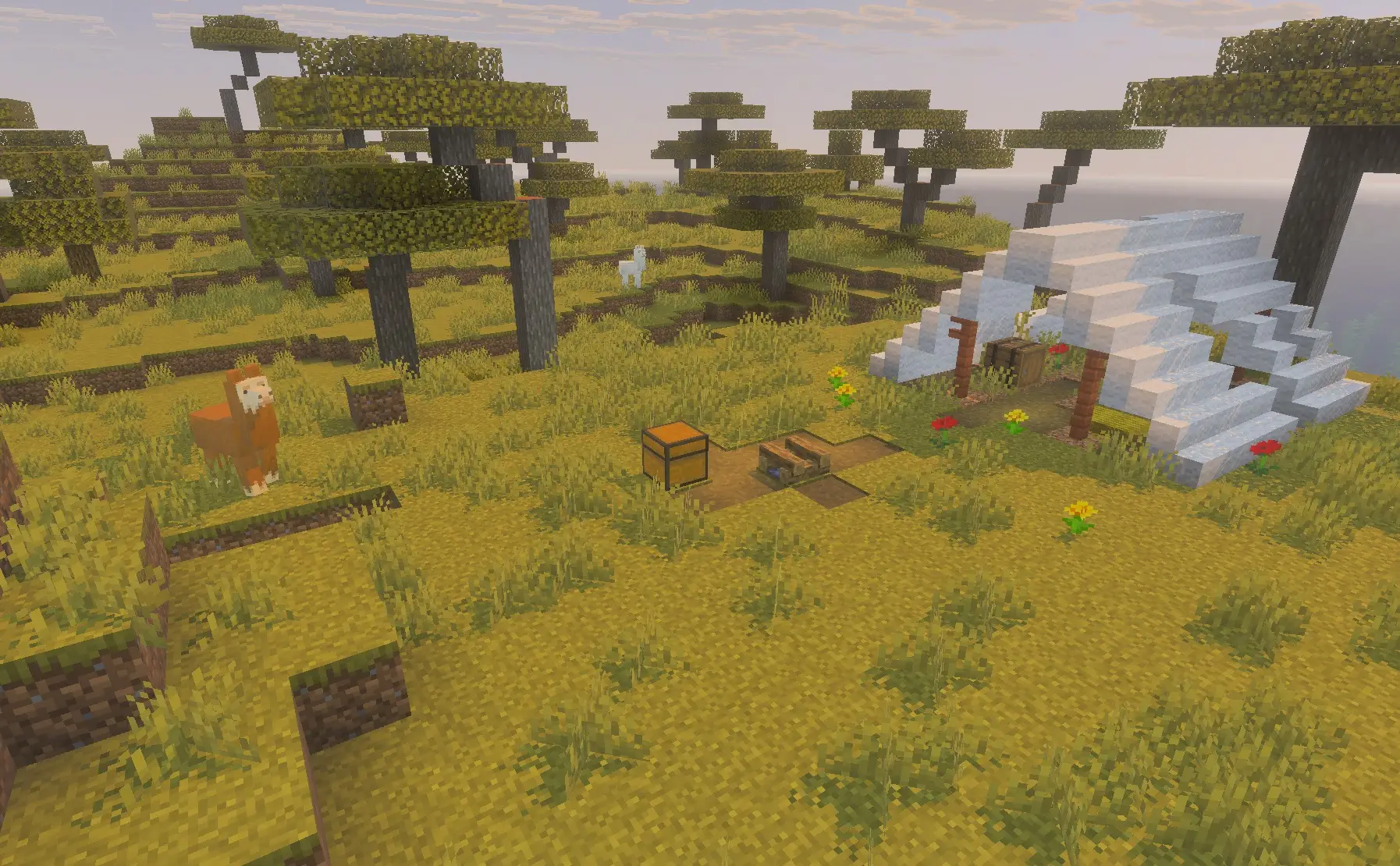
The centerpiece is a tent built from wool stairs. Early footage showed white wool, but Mojang has indicated camps can generate with any wool color, so don't assume you're only looking for white.
Around and inside the tent, you'll typically find:
- Chests and barrels — the main loot containers
- An unlit campfire — deliberately cold, reinforcing the "abandoned" theme
- A crafting table — instantly useful if you stumble in early
- Cauldrons
- Hay bales
- Oak fences
- Copper lanterns (oxidized)
- Oxidized copper golem statues — a nice decorative pull
- Dirt, gravel, and dirt path blocks forming the tent floor and surrounding ground
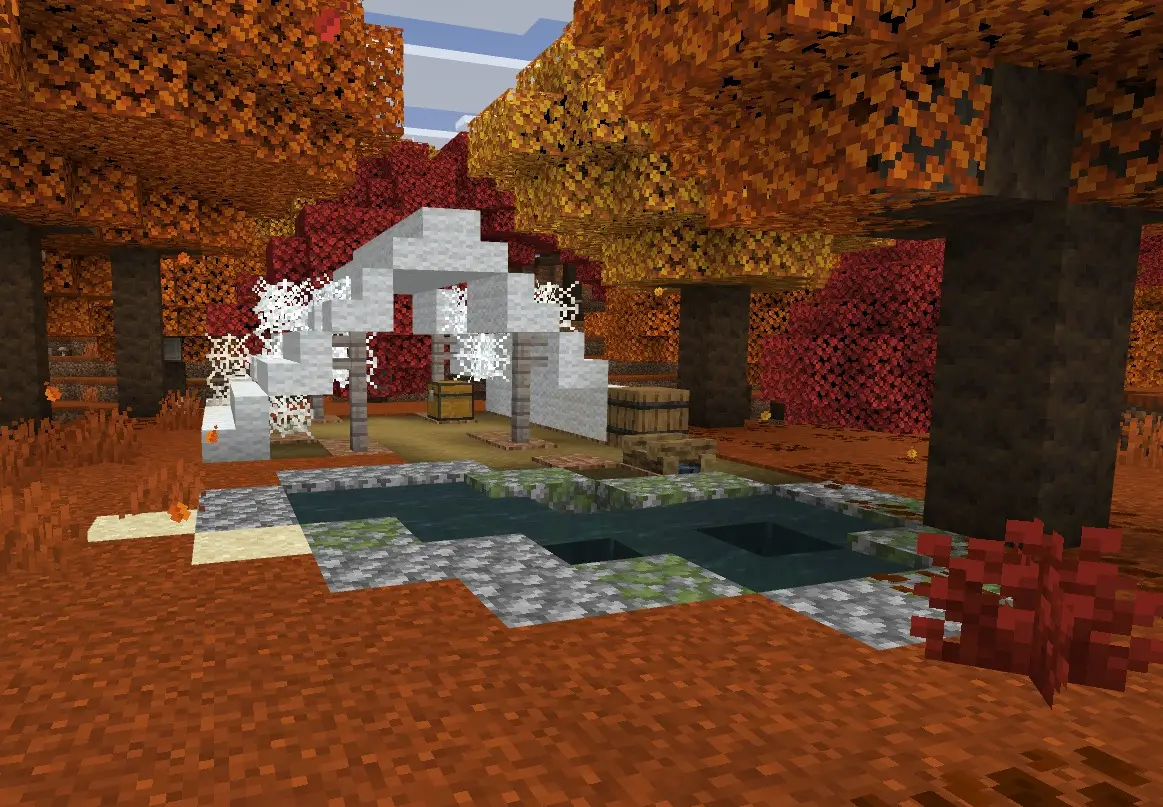
Some camps generate in a more ruined state, with cobwebs and oak leaves replacing sections of the wool tent. Others come with extra features nearby, like a small crop farm (wheat, carrots, potatoes on farmland) or a tree.
Camps Adapt to Their Biome
One of the nicer touches: the camp's dressing changes depending on where it generates. The core structure stays the same, but the surrounding blocks match the local environment.
- A camp in a cherry grove picks up cherry-themed blocks and cherry leaves
- A camp in the new dappled forest comes surrounded by poplar wood, leaf litter, and shelf mushrooms
- Other variants have been spotted with stone windbreaks, mossy cobblestone walls, and collapsed leaf-covered tents
This means no two camps feel identical, even though the underlying layout repeats.
Where to Find Them
Here's another point where sources disagree, so let's separate what's confirmed from what's circulating.
The official Minecraft Wiki describes abandoned camps as generating in any Overworld surface biome. Several third-party guides have narrowed this to a specific count of 18 biomes, listing things like forest, birch forest, taiga, savanna, swamp, cherry grove, meadow, wooded badlands, bamboo jungle, pale garden, and dappled forest.
The practical takeaway either way: camps are surface structures in common biomes, and you don't need to hunt for a rare environment. Ride or run across open forested and grassland terrain and you'll come across them naturally.
A few tips for spotting them:
- Look for the tent silhouette. A wool tent is a hard-edged, artificial shape against natural terrain. It stands out once you know what you're looking for.
- Travel on a horse. Camps reward covering ground quickly, and horses let you sweep wide flat areas fast.
- Dense biomes hide them. Dappled forests and dark forests have thick canopy that can obscure a camp from ground level. Climbing a hill or flying with an elytra helps.
- They're always above ground. Never dig looking for one.
If you're testing in a preview world with cheats enabled, you can also use the locate command:
/locate structure abandoned_camp
Keep in mind that command syntax and structure IDs can shift during development, and enabling cheats disables achievements.
The Loot
Camps use a tiered container system, which is what makes them worth stopping for rather than just walking past.
Barrels (Common)
Every camp has barrels holding everyday supplies: food, basic materials, and general early-game odds and ends. Nothing spectacular, but genuinely useful if you find a camp on day one or two.
Chests (Usually Present)
Most camps include at least one chest with better contents than the barrels: tools, copper gear, and occasionally something more valuable. Not every camp is guaranteed a chest, but barrels are consistent.
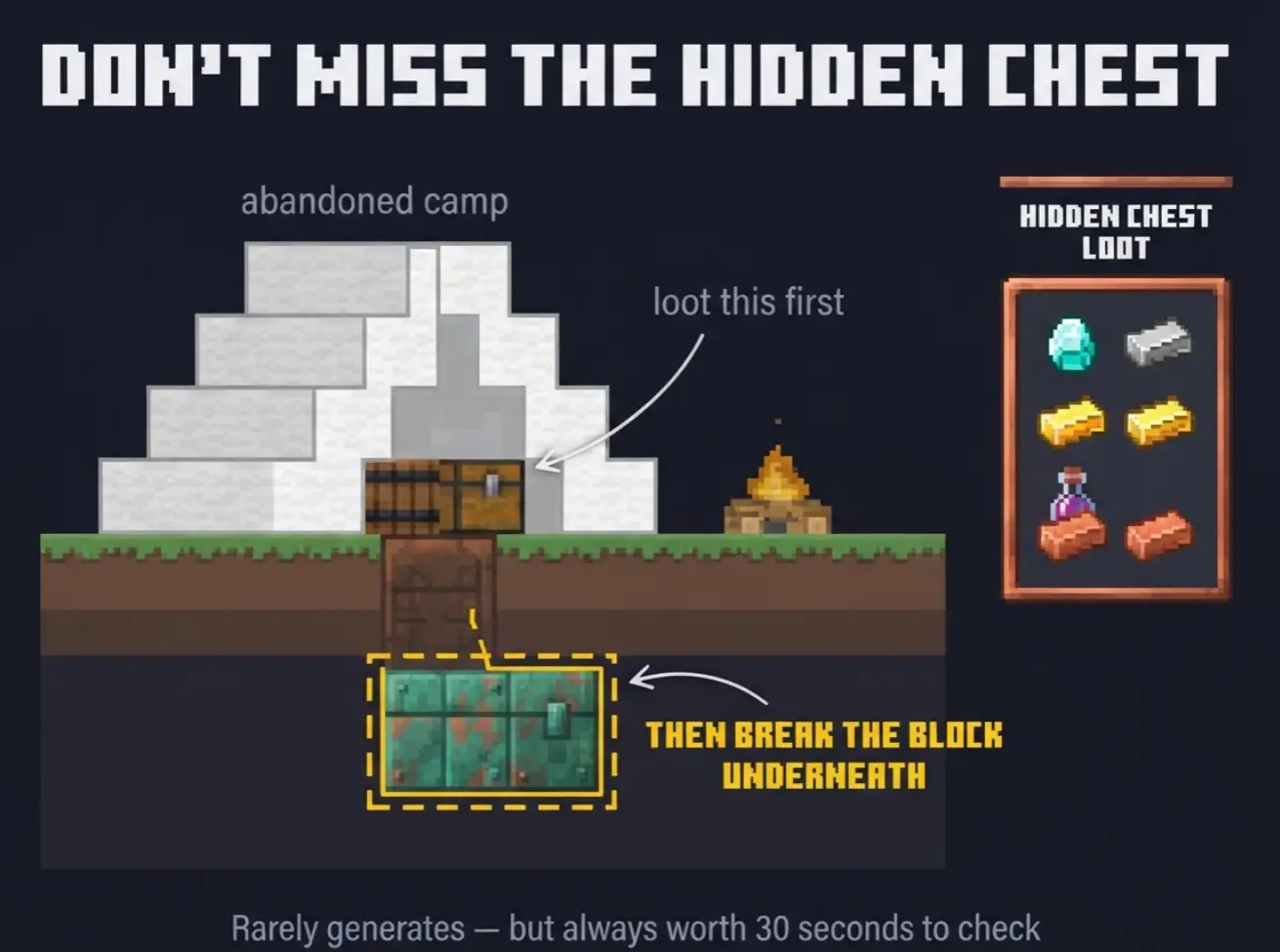
The Hidden Oxidized Copper Chest (Rare)
This is the real prize and the reason to spend an extra thirty seconds at each camp.
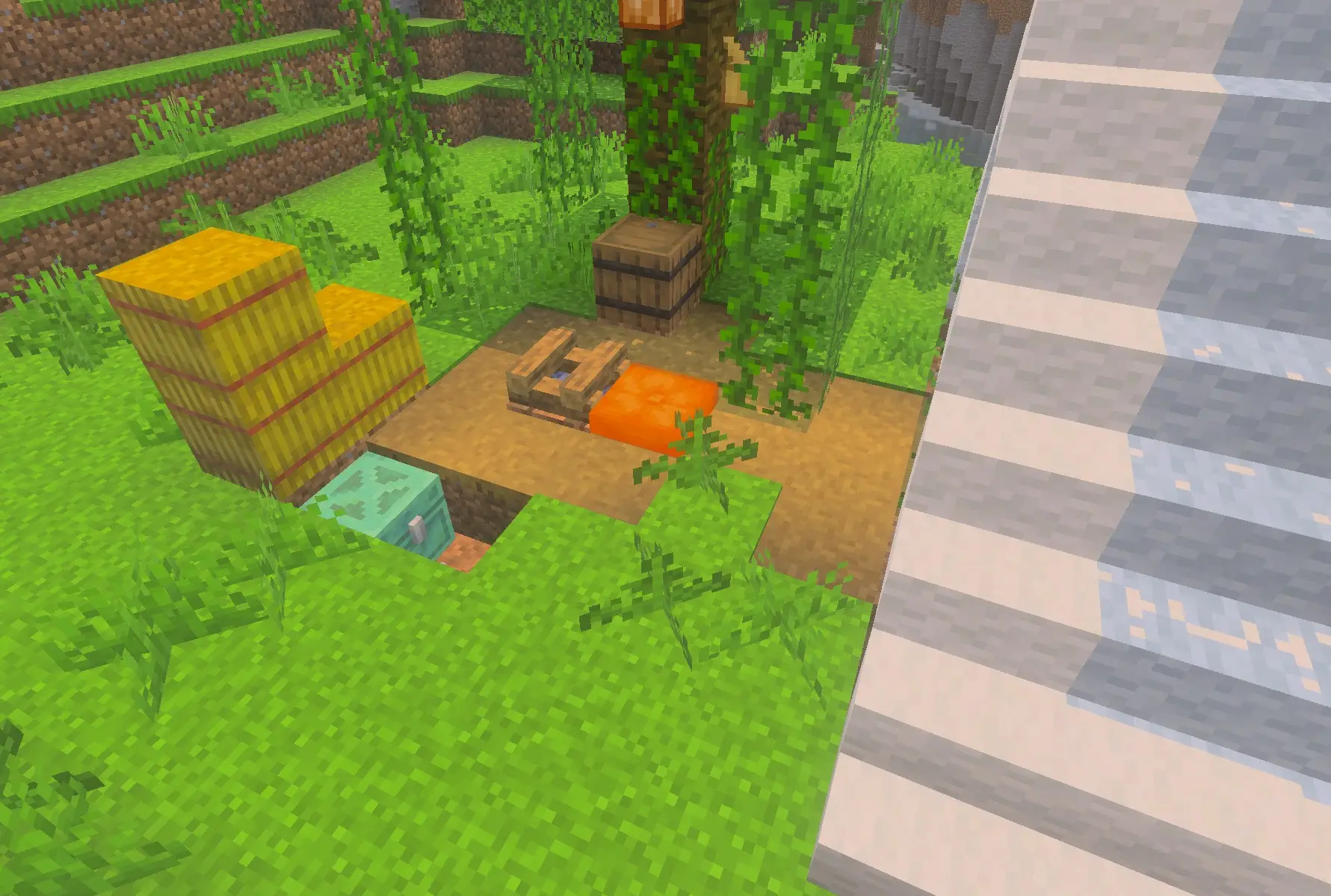
Rarely, a camp generates with an oxidized copper chest containing significantly better loot than the standard containers. Reports from preview builds mention diamonds, iron gear, brewed potions, and gold and copper ingots.
The important detail: this hidden chest sometimes generates directly beneath one of the standard containers. If you loot a barrel and walk away, you might be standing on top of the best chest in the structure without knowing it.
So the habit worth building: after you empty the visible containers, break the block underneath them and check. It costs almost no time and occasionally pays out a stack of diamonds.
Blocks Worth Taking Home
The loot isn't the only reason to visit. Several blocks in the camp are worth mining and carrying back.
Wool stairs and slabs. These are new blocks introduced in the same drop. Grabbing a tent's worth gives you a head start on building with them before you've set up a sheep farm and crafting chain.
Oxidized copper golem statues. A decorative block that's excellent for builds and not trivially craftable.
Copper lanterns. Good lighting blocks with a distinctive look.
The crafting table and cauldron. Free utility blocks if you're early in a world.
Using a Camp as a Starter Base
An abandoned camp is close to a ready-made first base. You get shelter, a crafting table, storage containers, a campfire spot, and often a small crop farm, all in one place.
To convert one:
- Loot everything first, including checking under the containers for the hidden copper chest
- Relight the campfire with flint and steel for light and passive cooking
- Seal the tent with a door and patch any gaps in the wool walls
- Light the interior with torches so nothing spawns inside
- Keep the barrels as your starter storage rather than breaking them
- Expand the crop farm if the camp generated with one
It's not a permanent base, but for the first few in-game days it beats digging a hole in a hillside.
If the starter-base idea appeals to you, there's a Bedrock seed with an isolated island containing an abandoned camp, which makes for an excellent survival island challenge. You start with shelter, storage, and a crafting table already built, but nothing else around you. A camp on an island is a very different survival experience from finding one mid-journey across a forest.
How Camps Compare to Other Loot Structures
Abandoned camps occupy an interesting middle ground:
vs. Villages: smaller, no villagers, no trading, but far more common and no iron golem to worry about. Camps are a quick stop; villages are a destination.
vs. Pillager Outposts: camps have no hostile mobs guarding them. You can loot in peace.
vs. Desert Temples / Jungle Temples: camps have no traps, no puzzle, and no TNT waiting for you. Lower risk, lower ceiling on loot, but far more frequent.
vs. Woodland Mansions / Ancient Cities: not remotely comparable in danger or reward, but you'll find a hundred camps in the time it takes to find one mansion.
The design intent seems clear: camps are meant to be a reliable, low-friction reward for exploring rather than a rare landmark.
What's Still Unclear
Since this is a pre-release feature, several things haven't settled:
- Exact spawn frequency. Described as common, but no confirmed generation rate
- Full loot tables. Item pools and probabilities are still being tuned
- Final biome list. "Any Overworld surface biome" versus a specific curated list
- Bedrock parity timing. The Bedrock experiment is live in Preview, but full release timing may differ slightly from Java
- Some item reports. A few sites mention specific new weapons in camp chests. These claims come from single sources and aren't confirmed in official changelogs, so treat them cautiously
If you're reading this after the Q3 2026 release, expect some of the above to have changed. We'll update as details firm up.
How to Try Them Right Now
If you want to explore camps before the stable release:
- Install Minecraft Preview (a separate app from the main game on Bedrock)
- Create a new world
- Enable the toggle for the 2026 Drop 3 experimental features
- Generate the world and start exploring surface biomes
Two warnings. First, worlds with experimental features enabled are permanently marked and can't have experiments turned off later. Second, experimental worlds can break between preview updates, so never enable this on a world you care about. Make a throwaway world for testing.
Wrapping Up
Abandoned camps look like a small addition, but they solve a real problem: the mid-journey stretch of Minecraft where you're travelling across terrain with nothing to interact with. A common surface structure with tiered loot, free utility blocks, and a hidden chest that rewards curiosity is a smart way to make overland travel feel worthwhile.
The one habit to build now: always check underneath the barrels and chests. That's where the copper chest hides, and it's the difference between a handful of bread and a stack of diamonds.