
Minecraft Java vs Bedrock: Every Difference That Still Matters
Search for "Java vs Bedrock" and you'll find comparison lists that are years out of date. They warn you that Bedrock has no Hardcore mode, no Spectator mode, and completely different worlds from the same seed. None of that is true anymore. At the same time, those lists often skip the differences you'll actually notice the first time you play, like how combat feels or why a redstone build from a Java tutorial refuses to work.
This guide sorts it out properly: what's genuinely different between Minecraft Java and Bedrock today, what used to be different and has since been fixed, and the "differences" people still repeat that were never real. If you're deciding which edition to buy, or you just switched and something feels off, start here.
The Quick Answer
Java and Bedrock are the same core game: the same biomes, mobs, blocks, and major updates, usually released on the same day. The real differences come down to a handful of areas:
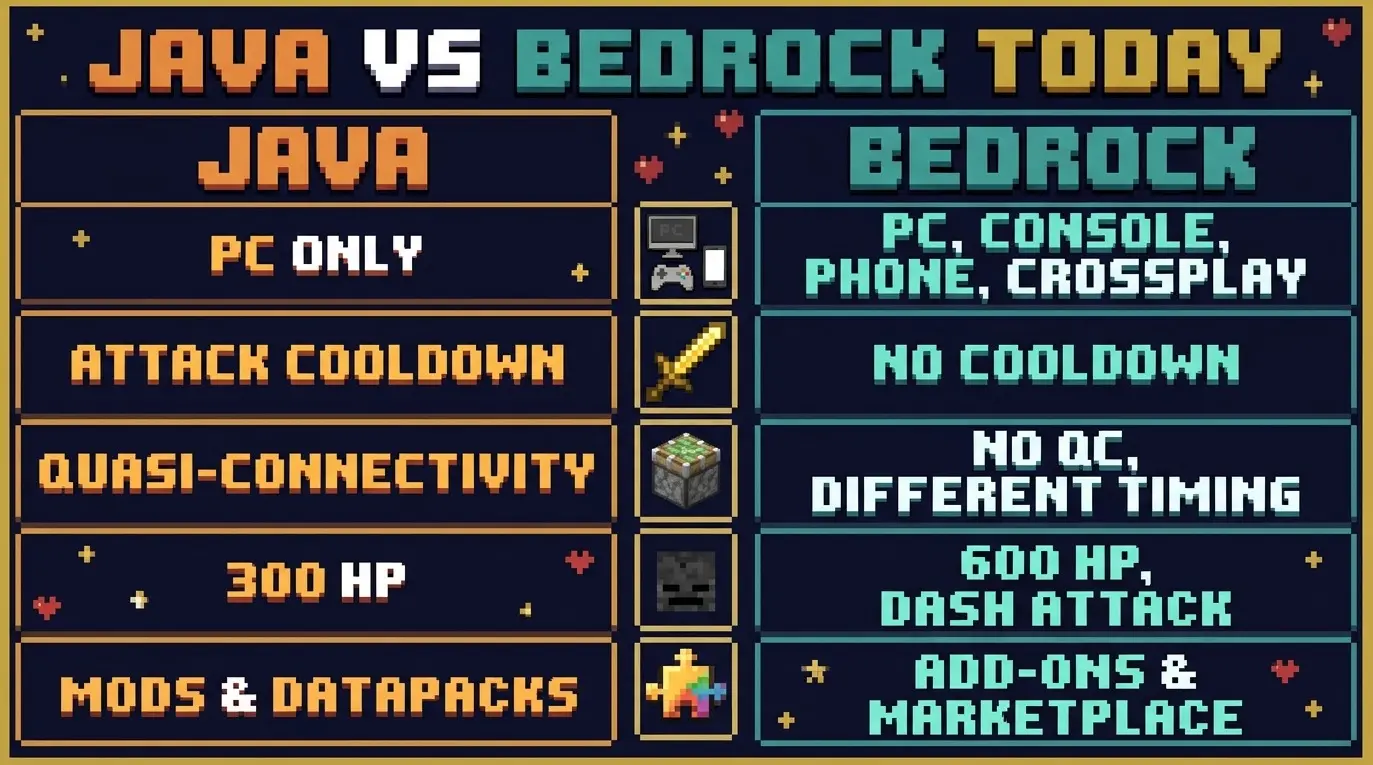
- Platforms and crossplay: Java runs only on PC and plays only with Java. Bedrock runs on PC, consoles, and phones, and all of them play together.
- Combat: Java has an attack cooldown. Bedrock doesn't.
- Redstone: Java has quasi-connectivity and different timing, so many technical builds don't port between editions.
- Mobs and bosses: spawning rules, the Wither, raids, and a few mob behaviors differ.
- Modding: Java has full mods and datapacks. Bedrock has add-ons and the Marketplace.
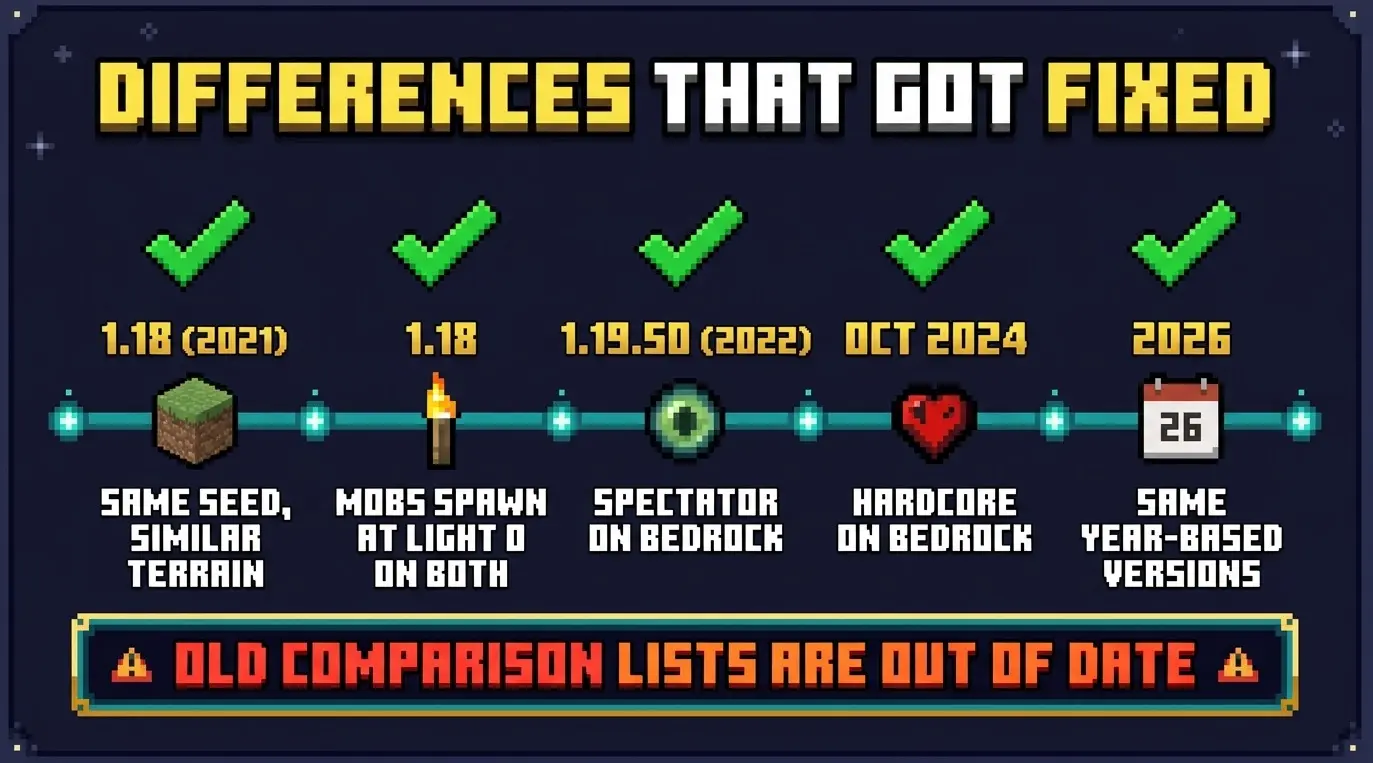
Meanwhile several old differences are gone: Bedrock now has Spectator and Hardcore modes, seeds generate very similar terrain on both editions, and mob spawning uses the same light rule.
Platforms, Price, and Playing Together
This is the biggest practical difference, and it usually decides which edition someone ends up with.
- Java Edition runs on Windows, macOS, and Linux. It can only connect to other Java players, through servers, LAN, or Java Realms.
- Bedrock Edition runs on Windows, Xbox, PlayStation, Nintendo Switch, iOS, and Android. Every Bedrock platform can play with every other one. Our guide to Bedrock crossplay covers the setup.
- Java and Bedrock can't play together natively. Realms are locked to one edition too. Some Java servers run an unofficial bridge called Geyser that lets Bedrock players join, but that's a server-side add-on, not a built-in feature.
- Split-screen is Bedrock-only, and only on consoles. Java has no split-screen at all. See our split-screen guide.
- On PC you get both. Minecraft for PC is sold as "Java & Bedrock Edition" in one purchase, so PC players don't actually have to choose. On consoles and phones, Bedrock is the only option.
Combat: The Difference You'll Feel First
Switch editions and the first thing your hands notice is combat.
- Attack cooldown. Java has had an attack cooldown since the 1.9 combat update: swing too fast and your hits deal only a fraction of their damage. Bedrock has no cooldown. Each click hits at full strength, much closer to old-school Minecraft combat. This even applies to heavy weapons, which is why the mace on Bedrock can be swung freely while Java players wait out a long recharge.
- No sweeping attacks on Bedrock. Java swords hit nearby mobs with a sweep, and the Sweeping Edge enchantment boosts it. Bedrock has no sweep attack, so Sweeping Edge doesn't exist there.
- Shields. Both editions use shields, but on Bedrock you can raise yours simply by sneaking, which is handy on touch screens and controllers.
Redstone and Farms
This is where copying a Java tutorial onto Bedrock most often goes wrong.
- Quasi-connectivity is Java-only. On Java, pistons, droppers, and dispensers can be powered by a signal one block above them. Many famous Java contraptions rely on this quirk. Bedrock doesn't have it, so those builds simply don't fire.
- Timing and update order differ. A one-tick pulse on Java doesn't behave the same on Bedrock, and piston, observer, and hopper timings vary. Compact or fast Java designs frequently break.
- Chunk loading works differently. Bedrock has no always-loaded spawn chunks. Farms only run near a player, unless you keep the area loaded with the
/tickingareacommand. - Mob spawning is tied to simulation distance on Bedrock. At low simulation distances, hostile mobs spawn in a much tighter ring close to the player than on Java, where they can appear up to 128 blocks away. That's why Java mob-farm designs often produce little or nothing on Bedrock.
The practical rule: when you follow a redstone or farm tutorial, make sure it was built for Bedrock. Most simple circuits (doors, lamps, basic piston doors) work on both. Technical builds usually don't.
Mobs and Bosses
- The Wither is much harder on Bedrock. It has 600 health instead of Java's 300, gains a dash attack at half health that smashes through blocks, and summons wither skeletons on Normal difficulty or higher. Strategies that work on Java often aren't enough.
- Raids scale differently. On Java, a higher Bad Omen level adds bonus waves. On Bedrock the level doesn't matter: raid size depends on world difficulty.
- Mob heads are decoration only on Bedrock. Wearing a mob's head halves its detection range on Java, but does nothing on Bedrock, and player heads don't drop from charged creepers.
- Smaller behavior differences show up across the game. Drowned can spawn in shallow water on Bedrock, and the Regeneration bonus axolotls give you in combat is uncapped on Bedrock but capped at 2 minutes on Java (covered in our axolotl guide).
Items, Inventory, and Interface
- Off-hand. Java lets you hold almost anything in your off-hand. Bedrock limits it to a short list, such as shields, totems, arrows, firework rockets, and maps. You can't hold a bucket or a block there.
- Cauldrons do more on Bedrock. A Bedrock cauldron can hold potions and dyed water, which lets you tip arrows and dye leather armor in it. Java cauldrons hold water, lava, and powder snow only.
- No F3 screen on Bedrock. Java's F3 debug screen shows coordinates, biome, light level, and more. Bedrock instead has a "Show Coordinates" setting and no built-in light-level readout, which matters when you're spawn-proofing a base.
- Achievements vs advancements. Bedrock uses Microsoft/Xbox achievements, and turning on cheats disables them permanently for that world. Java uses advancements, which work regardless.
Commands and Game Rules
Basic commands like /tp, /give, and /gamemode exist on both editions and mostly behave the same. Differences appear in the details:
- Random tick speed. The default
randomTickSpeedis 3 on Java and 1 on Bedrock, and the two numbers don't translate one-to-one because the editions process random ticks differently. Never paste a Java value into a Bedrock world and expect the same result. - Item data. Java commands use data components and NBT, while Bedrock uses its own JSON-style syntax. Complex
/giveor/executecommands copied from Java often fail on Bedrock. - Bedrock-only commands exist too, such as
/tickingareafor keeping chunks loaded.
Mods, Add-ons, and Graphics
- Java has the bigger modding scene. Fabric, NeoForge, and Forge mods, datapacks, and plugin servers like Paper give Java almost unlimited customization.
- Bedrock uses add-ons and the Marketplace. Add-ons come as .mcaddon and .mcpack files built from behavior packs and resource packs, and the Marketplace sells skins, worlds, and packs for Minecoins, which follow your account across devices (see our Marketplace and Minecoins guide). Java has no Marketplace.
- Graphics. Bedrock on Windows supports ray tracing on compatible graphics cards, and Bedrock received Mojang's Vibrant Visuals graphics overhaul in 2025. Vibrant Visuals for Java has been announced but is still in development with no release date. On Java, shaders come from mods instead.
- Performance. Bedrock generally runs more smoothly on low-end hardware. Java often needs performance mods to match it.
Differences That Used to Exist (and Are Now Fixed)
This is the section most comparison articles are missing. Mojang has spent years bringing the editions closer together, and many classic "Bedrock can't do that" complaints are history:
- Spectator mode arrived on Bedrock in version 1.19.50 (November 2022) as a full game mode, no experimental toggle needed. Turn on cheats, then switch via your game mode setting or
/gamemode spectator. - Hardcore mode came to Bedrock in October 2024 with the Bundles of Bravery drop. One detail differs from Java's long-standing version: when you die in Bedrock Hardcore, the world isn't deleted, but you can only spectate it from then on.
- Seeds and world generation. Before the 1.18 Caves & Cliffs update, the same seed made totally different worlds on each edition. Since 1.18 the terrain generates very similarly. It still isn't block-for-block identical, and structures, ores, and small features can be placed differently, but the landscape broadly matches.
- Mob spawning light level. Both editions now spawn hostile mobs only at block light 0, after the 1.18 lighting changes. Old "keep it above light 7" advice is outdated on both.
- Update timing. In Bedrock's early years the editions got features at different times. Today, major updates and game drops (Tricky Trials, Bundles of Bravery, and the drops since) launch on both editions together, and Bundles, after years as a Java experiment, finally shipped to both at once.
- Version numbers. From 2026, both editions use year-based version numbers starting with "26", so it's easier to tell that a Java and a Bedrock release are from the same era. The numbers after the prefix still differ between editions.
"Differences" That Aren't Real
Plenty of advice online assumes Bedrock works differently when it doesn't. These all behave the same on both editions:
- Lodestones now cost an iron ingot on both editions, not netherite. The recipe changed on Java in 1.21.5 and on Bedrock in 1.21.70.
- Bad Omen comes from drinking an ominous bottle on both editions since 1.21. Killing a captain no longer applies it directly anywhere.
- Waxing copper with honeycomb, froglight colors from frog variants, and the recovery compass all work identically.
- Core survival, meaning crafting recipes for the basics, biomes, ores, and most mob behavior, is the same game.
That's the honest picture: the editions share far more than they differ, and a good chunk of what people "know" about the differences is either outdated or never applied to Bedrock in the first place.
Which Edition Should You Pick?
Pick Java if you want mods, technical redstone and farm designs, or the huge ecosystem of community servers, and you only play on a computer.
Pick Bedrock if you want to play with friends on consoles or phones, play split-screen on the couch, run the game on modest hardware, or use the Marketplace, ray tracing, and Vibrant Visuals.
If you're on PC, the question mostly answers itself: one purchase includes both, so you can play Java for mods and Bedrock for crossplay with friends.